
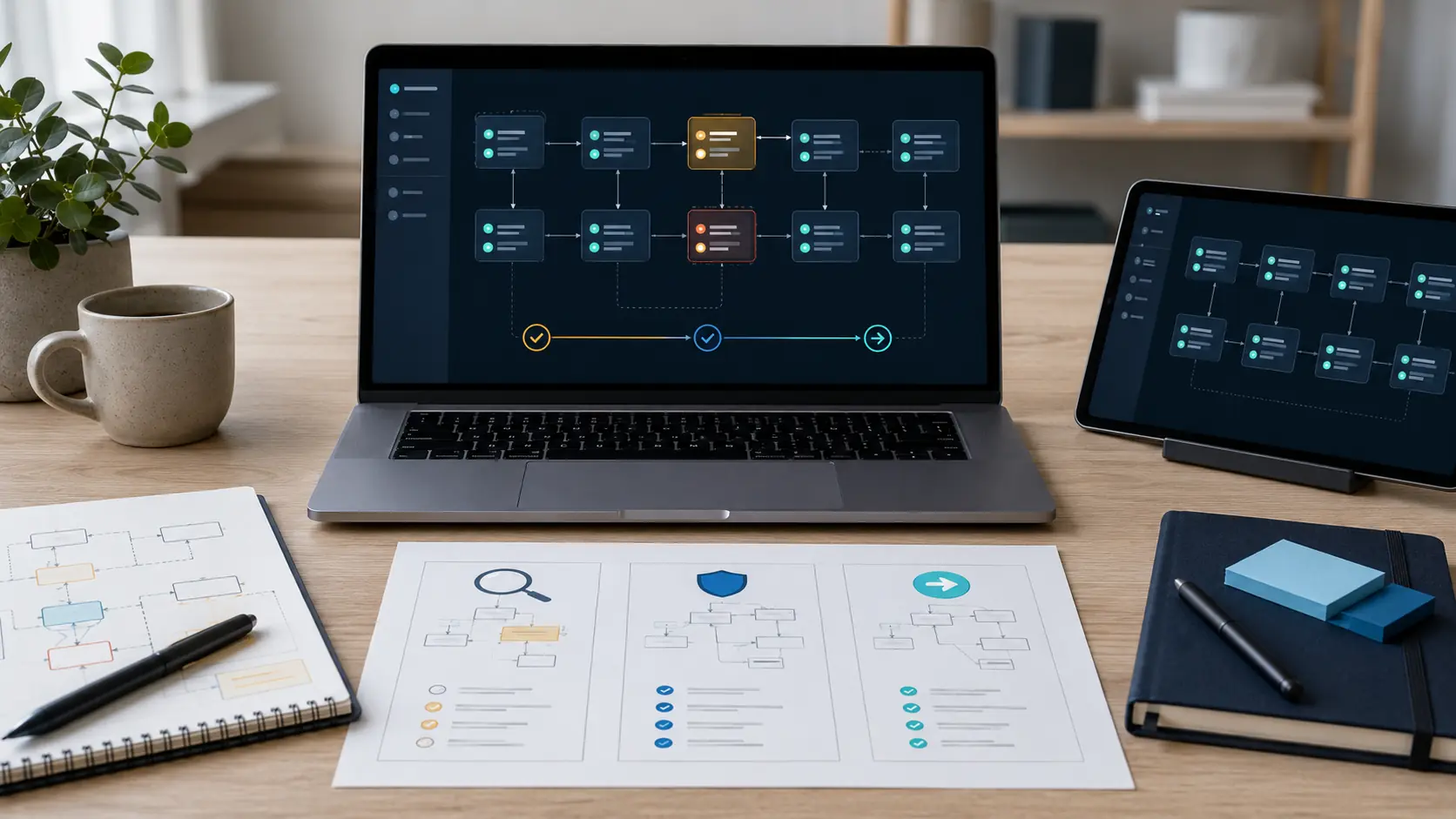
A stalled product is not always a failed product
Repeated delays, fragile releases, undocumented decisions, recurring incidents and a backlog that never becomes value are warning signs. The cause may be technical debt, unclear ownership, an unrealistic scope or dependence on unavailable people.
Avoid deciding to rebuild before understanding which parts still work and which business knowledge is embedded in the current system.
Diagnose technology and operation together
Review the codebase, infrastructure, data, security, deployment process, integrations and automated tests. At the same time, identify critical user journeys, current business priorities and the people who know how the operation really works.
The diagnosis should distinguish urgent risks from maintainability issues and desirable improvements.
Stabilize before adding more scope
Protect data, document environments, restore reproducible deployments and address incidents that threaten continuity. Freeze changes that increase risk until the team can release and recover safely.
This stage may not produce visible features, but it creates the conditions for dependable progress.
Create a roadmap based on evidence
Group work into continuity, correction and evolution. Estimate uncertainty explicitly and deliver in small, verifiable increments. Rebuilding is justified only when evidence shows that adapting the current system is more dangerous or costly than replacing it.
Leave the product easier to continue
Record technical decisions, establish ownership, maintain access inventories and define how work is reviewed and released. A rescue is successful when the product can evolve without depending on a single person or another emergency intervention.
Frequently asked questions
Does a troubled system always need to be rebuilt?
No. A technical and operational diagnosis should determine what can be preserved safely.
Can another team continue an incomplete system?
Often yes, if access, code, environments and business rules can be recovered and evaluated.
Need to apply this to your operation?
We can help you turn this approach into a clear scope and practical path.
Learn about system rescue and improvement →